



Specialized and up-to-date educational brochures with a practical approach, prepared to facilitate learning and knowledge transfer at various professional levels.
Waste Management: A Step-by-Step Guide for Industries
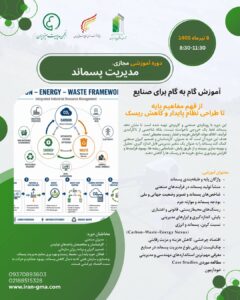
Waste Management; A Step-by-Step Guide for Industries
Waste management in today's industries is no longer limited to the collection and disposal of waste, but is also recognized as part of resource management, increasing productivity, and moving towards sustainable production. The educational booklet "Waste Management; A Step-by-Step Guide for Industries" has been developed with the aim of familiarizing managers and experts with new approaches to waste management, reducing costs, and transforming waste from an operational challenge into an economic opportunity.
This training emphasizes the importance of changing the traditional view of waste; In such a way that waste is not seen as an unavoidable cost, but as a recyclable resource with economic value. In this direction, concepts such as reduce at source, reuse, recycle, recover and design for rotation are introduced as the main principles of the circular economy.
One of the important focuses of this booklet is introducing the concept of circular economy; an approach that attempts to maintain the value of materials, energy, and products for a longer period in the production cycle and reduce the amount of waste generated. Implementing this model can help reduce dependence on raw materials, reduce disposal costs, generate revenue from waste, and increase the competitive advantage of organizations.
This training also examines the relationship between waste, energy, and carbon. Every material that becomes waste contains energy and carbon in the extraction, production, and processing stages; Therefore, reducing waste can lead to reduced energy consumption and reduced greenhouse gas emissions. This approach makes waste management one of the important tools on the path to reducing carbon footprint and low-carbon development.
The booklet also discusses performance evaluation indicators such as material turnover rate, recycled material usage, cost reduction from waste management, and life cycle assessment (LCA) so that organizations can monitor their environmental and economic performance more accurately.
Audience of this training:
Industrial managers, environmental and HSE experts, production managers, organizational sustainability officers and all those interested in resource management and sustainable production.
This booklet helps organizations to improve their waste management system, in addition to reducing environmental impacts, control operating costs, increase resource efficiency and move towards a circular economy and green industry.
Financial management knowledge for non-financial managers in the carbon era
Financial Management for Non-Financial Managers in the Carbon Age; From Cost Control to Smart Resource Management
In today's world, organizational management is not limited to controlling costs and increasing profits; rather, resource efficiency, risk reduction, energy, water, waste, and carbon emission management have become an important part of management decisions. The educational booklet "Financial Management for Non-Financial Managers in the Carbon Age" has been developed with the aim of creating an integrated view between financial concepts and sustainable resource management.
This booklet helps non-financial managers understand how everyday decisions in areas such as equipment purchases, energy consumption, process management, waste reduction, and resource use affect the organization's cost, profitability, risk, and performance. In this approach, energy, water, waste, and carbon are not separate issues from financial management, but are part of the organization's value creation system.
The content of this training includes concepts such as:
- Introducing non-financial managers to basic financial concepts and explicit and implicit costs
- The relationship between resource consumption and the organization's financial consequences
- Integrated energy, water, waste and carbon management
- The role of carbon in investment decisions and risk management
- Management Indicators for Measuring Resource Efficiency
- Designing management dashboards for smart decision-making focuses.
One of the key themes of this booklet is changing the management perspective from "reducing short-term costs" to "creating sustainable value." In this perspective, reducing resource consumption, eliminating waste, increasing productivity, and reducing environmental impacts can simultaneously reduce costs and increase the organization's resilience.
This training also shows that carbon is no longer just an environmental issue; Rather, it has become a management, economic and competitive indicator. Managing carbon emissions, energy intensity, water consumption and waste can play an important role in reducing future risks, increasing competitiveness and preparing organizations for new market requirements.
The audience for this booklet:
Organizational managers, production and operations managers, human resource managers, HSE managers, sustainability experts, non-financial managers and all those involved in organizational decision-making.
This booklet is an attempt to create a common language between financial management, resource efficiency and sustainable development; So that organizations can move towards a lower-cost, more resilient, and sustainable future through smart carbon, energy, water, and waste management.
Non-financial managers in the carbon era
Roadmap for the development of knowledge on "Climate Change" Engineering/Industrial Path
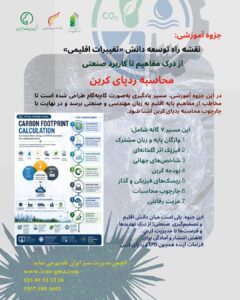
Basics of Climate Change and Industrial Application of Carbon Footprint Calculation
Climate change is one of the most important challenges of our time, mainly caused by the increase in the concentration of greenhouse gases in the Earth's atmosphere. These gases, by absorbing and reflecting part of the infrared radiation emitted by the Earth, disrupt the planet's energy balance and cause global warming. Scientific evidence shows that the average temperature of the Earth has increased by more than one degree Celsius compared to the pre-industrial era, the concentration of carbon dioxide has increased from about 280 to more than 420 ppm, and the frequency of extreme events such as droughts, floods, and heat waves is increasing.
In the face of climate change, there are two main approaches: mitigation, which focuses on reducing greenhouse gas emissions, and adaptation, which aims to reduce the vulnerability of organizations and infrastructure to the inevitable consequences of climate change. Examples of adaptation include water recycling, infrastructure retrofitting, and increasing supply chain resilience.
Carbon Footprint is the total greenhouse gas emissions of a product, organization, service or activity, usually reported in CO₂e. In contrast, Life Cycle Assessment (LCA) examines the entire environmental impact of a product from the extraction of raw materials to the end of its life. Therefore, carbon footprint is a subset of LCA and focuses solely on climate impacts, while LCA also assesses indicators such as water consumption, acidification, ozone depletion and resource consumption.
In industry, climate change poses significant risks to businesses in addition to environmental impacts. These risks include physical risks such as water scarcity, rising temperatures and damage from floods and storms, and transition risks including carbon taxes, reporting requirements, the need for EPDs and market pressure to produce low-carbon products. Therefore, carbon footprint calculation and management has become a strategic tool for maintaining the competitiveness and resilience of organizations.
Carbon footprint calculation is carried out at two levels: the Corporate Carbon Footprint (CCF), which examines Scope 1, Scope 2 and Scope 3 emissions at the organization level, and the Product Carbon Footprint (PCF), which evaluates emissions related to the life cycle of a product. To perform a valid calculation, it is necessary to determine the purpose of the study, define the assessment boundaries, collect reliable data and choose the appropriate reporting method.
Ultimately, carbon footprint calculation is not only an environmental activity, but also a management tool to identify high-emission points, reduce costs, respond to market requirements and move towards sustainable development and a low-carbon economy.
From Water Understanding to Water Intelligence: Sustainable Management in the Era of Climate Change and Water Resources Credibility
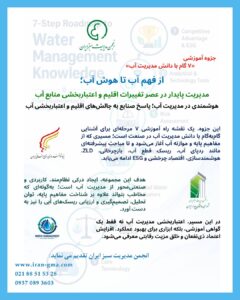
From Water Understanding to Water Intelligence; Sustainable Management of Water Resources in Industry
Water is one of the most important strategic resources for industrial and economic development, and its proper management has become increasingly important in the context of climate change and water stress. The first step in water management is to recognize the difference between Water Withdrawal and Water Consumption. Withdrawal refers to the amount of water that is received from the source, while actual consumption is the part of the water that does not return to the source and is removed from the cycle. This difference is of fundamental importance for assessing pressure on water resources and analyzing water risks.
One of the fundamental principles of water management is the law of conservation of mass or water balance, which states that the sum of water inputs must equal outputs plus changes in storage. This principle is the basis for water audits, identifying leaks, calculating actual consumption, and designing water recycling programs in industries. Any discrepancy in this balance can indicate measurement errors, hidden leaks, or weaknesses in the monitoring system.
In water loss analysis, a distinction must be made between real loss and apparent loss. Real loss results from physical leakage of water from lines, tanks or equipment, while apparent loss is related to measurement errors, data recording and improper calibration of equipment. Correct identification of these two types of loss is a prerequisite for selecting effective management and technical solutions.
Iran is in a state of structural water scarcity based on international indicators including Falconmark and Water Stress. The decline in per capita renewable water resources, the continuous decline in groundwater levels, land subsidence, and the increase in the number of critical plains indicate that water management should become one of the main priorities for industries and organizations. This situation will increase the risk of withdrawal restrictions, increase the cost of water supply, and tighten legal requirements for industries.
Globally, the ISO 14046 standard provides the main framework for assessing water footprint. This standard does not only measure the volume of water used, but also examines the environmental impacts of water use on resources, ecosystems and water-stressed areas. Such an approach is particularly important for sustainability reporting, ESG requirements and presence in international supply chains.
The concept of virtual water also shows that a significant part of water consumption lies in the supply chain of products. Many industries, despite relatively limited direct consumption, have a very large water footprint through their raw materials. Sustainable water management is therefore not limited to optimizing consumption within the factory but must encompass the entire supply chain.
Ultimately, industries face three main categories of water risk: physical risk (scarcity and drought), legal risk (harvest restrictions and regulations), and credential risk (social pressures and ESG requirements). Experience shows that the cost of stopping production due to water shortages can be many times the cost of supplying water. Therefore, measures such as water recycling, wastewater reuse, increasing productivity, developing monitoring systems, and reducing dependence on freshwater resources are considered among the most important strategies for increasing the resilience of industries against water crises.
Step by Step with Energy: A Guide to Auditing, Green Efficiency, and Carbon Reduction
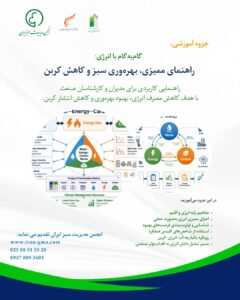
Energy Audit, Performance Indicators, and Efficiency Improvement Opportunities
Energy audit is a systematic process for identifying energy consumption patterns, evaluating equipment performance, and discovering opportunities to reduce energy consumption and costs. The success of an energy audit depends on the quality and comprehensiveness of the data collected. This data includes energy carrier consumption information, equipment technical specifications, operating conditions, technical documentation, financial information, and, if necessary, data related to the organization's carbon emissions and climate goals. The more accurate and disaggregated the data, the more reliable the audit results and the more effective management decision-making will be.
One of the most important steps in an energy audit is to identify the main points of energy consumption. In most industries, the highest energy consumption occurs in production processes, electric motors, heating systems, cooling and ventilation systems, compressed air equipment, and energy transmission and distribution networks. Focusing on these areas allows for the greatest savings.
Another important part of an energy audit is to identify energy losses. Losses may occur in the form of heat loss in boilers and steam lines, leaks in compressed air systems, low efficiency of electrical equipment, or improper operation of equipment. Many of these losses can be reduced by relatively simple measures such as proper insulation, fixing leaks, properly adjusting control equipment, and improving maintenance and repairs.
Another important part of an energy audit is the identification of energy losses. Losses may occur in the form of heat loss in boilers and steam lines, leaks in compressed air systems, low efficiency of electrical equipment, or improper operation of equipment. Many of these losses can be reduced by relatively simple measures such as proper insulation, fixing leaks, properly adjusting control equipment, and improving maintenance and repairs.
Key Performance Indicators (KPIs) are used to assess energy performance. One of the most important indicators is energy intensity, which shows how much energy is used to produce each unit of product or create each unit of economic value. Reducing energy intensity indicates improved efficiency and usually reduces carbon emissions. Another important indicator is specific energy consumption, which shows the direct relationship between energy consumption and production and allows the performance of industrial units to be compared with standards and similar units.
Equipment efficiency is also a key indicator of energy audit, indicating how much of the energy input is being converted into useful work. Factors such as equipment wear, poor maintenance, part-load operation, and incorrect settings can reduce efficiency. Reviewing equipment efficiency helps identify priorities for repair, renovation, and optimization.
Another important tool is the analysis of the share of major energy loads, which determines which sectors contribute the most to total energy consumption. This analysis helps managers focus resources and improvement investments on major energy consumers. Finally, by estimating the energy savings potential, the energy audit identifies opportunities to reduce consumption and outlines the path to implementing low-cost or capital-intensive measures to achieve greater efficiency, reduce costs, and reduce greenhouse gas emissions.